
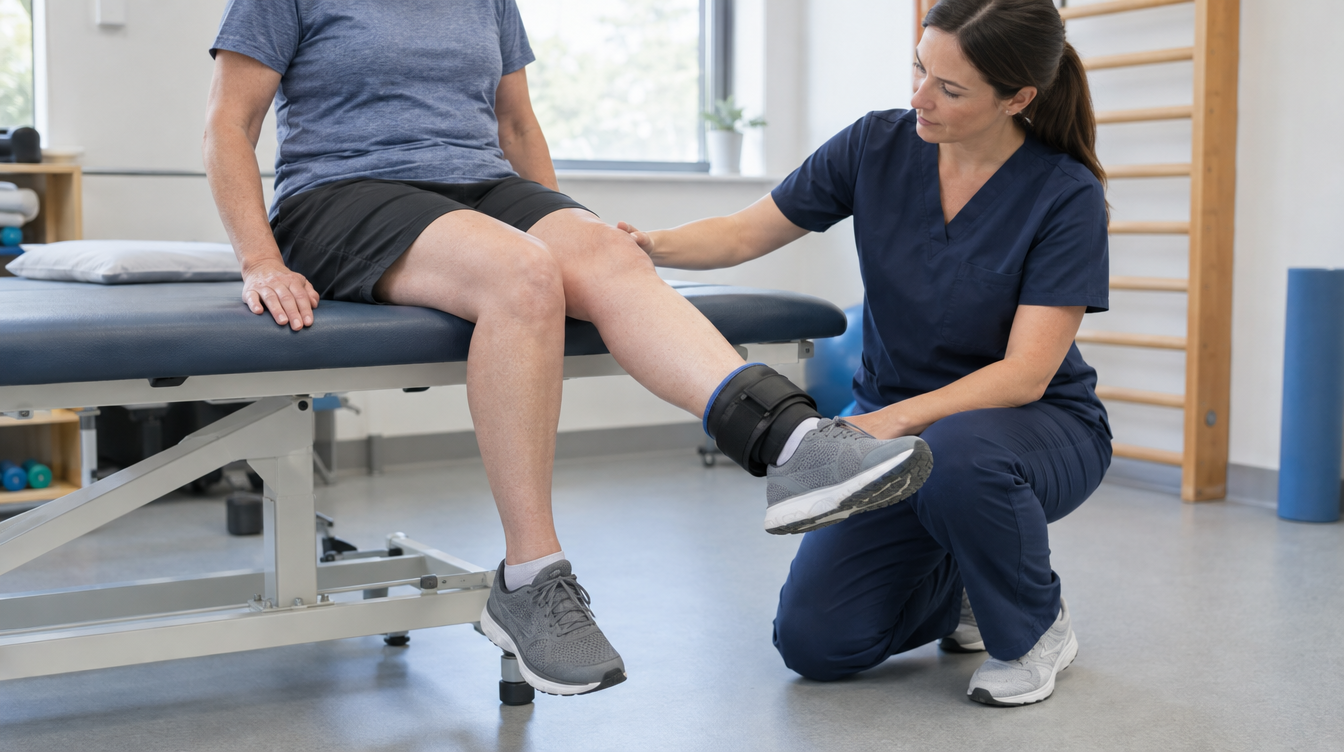
Monday morning, knee clinic
A familiar presentation in MSK clinics: activity-related knee pain in someone in midlife or older, worse on stairs and deep squats, morning stiffness that settles within about thirty minutes, no locking, no recent trauma, and no systemic red flags. Imaging is often requested “to see the wear,” and the conversation frequently turns to whether a manipulation or ultrasound will sort it.
That pattern is common across chiropractic, physiotherapy, osteopathy, and sports therapy. Knee osteoarthritis (OA) is common, clinically diagnosable in many cases, and still often framed as a problem that imaging or passive modalities will fix. The better first question is simpler: what does first-line care actually look like when we follow current guidance rather than habit?
Diagnose clinically — imaging is not the default
NICE NG226 (Osteoarthritis in over 16s, 19 October 2022) is clear. Diagnose OA clinically, without imaging, if the person is 45 or over, has activity-related joint pain, and has morning stiffness lasting no more than 30 minutes — or none at all (1.1.1). Do not routinely image unless features are atypical (1.1.2).
That does not ban imaging. It stops imaging from becoming the entry fee for a diagnosis that clinical features already support. For many people in front of you, the working diagnosis can be made in the room. Atypical features — night pain that wakes them, marked swelling with systemic symptoms, sudden locking with mechanical block, or a history that suggests inflammatory or infective disease — change the plan. Routine “confirm the OA” scans do not.
Core treatments are not optional extras
NG226 places therapeutic exercise, information and support, and weight management where appropriate at the centre of care (1.2.2). OARSI’s 2019 guideline (Bannuru et al.) lands in the same place for knee OA: arthritis education plus structured land-based exercise, with or without dietary weight management, as core.
That framing matters clinically. Exercise is not the thing you add after hands-on work “if there’s time.” It is the treatment you organise around. Manual therapy for hip or knee OA is considered only alongside exercise; NICE judges the evidence insufficient for manual therapy alone (1.3.6–1.3.7). Passive care can still have a role in settling irritability enough to move — but it is not a substitute for a loading plan the person can continue.
What therapeutic exercise actually means here
Offer therapeutic exercise tailored to the person’s needs — typically strengthening and aerobic work — to all people with OA (NG226 1.3.1). Consider supervised sessions (1.3.2). Advise that pain may increase initially, but that regular, consistent exercise benefits the joints; long-term adherence improves pain, function, and quality of life (1.3.3). Consider combining exercise with an education and behaviour-change package (1.3.4).
In practice that means:
- Match load to current capacity, then progress.
- Prefer programmes the person can sustain beyond six clinic visits.
- Supervise early when confidence, technique, or flare risk needs closer support.
- Treat education as part of treatment: what OA is and is not, why strength and aerobic capacity matter, and how to interpret early discomfort versus harmful overload.
“Therapeutic exercise” is not a single protocol. For one person it is quadriceps and hip strengthening plus walking. For another it is cycling, sit-to-stand progressions, and a graded stair plan. The common thread is planned, progressive loading with a clear rationale the patient can repeat back to you.
What the Cochrane update actually shows
The 2024 Cochrane update by Lawford and colleagues (CD004376) synthesised 139 trials including 12,468 people with knee OA. Land-based exercise was compared with attention or placebo controls, with usual care / no treatment / limited education, or added to a co-intervention.
Certainty was low to moderate. Short-term improvements were seen in pain, function, and quality of life. Importantly, the review is honest about clinical importance: benefits were of uncertain clinical importance against commonly used minimum important difference (MID) thresholds on 0–100 scales (pain 12, function 13, quality of life 15). Many trials were unblinded or small. Adverse events may increase in some comparisons.
That caveat belongs in the clinic conversation. Exercise remains guideline-supported first-line care. It is not magic, and average effects in trials are modest relative to MID cut-offs. People still improve with consistent programmes; many need realistic expectations, graded progression, and support with adherence rather than a promise of rapid, large average effect sizes.
What not to sell as primary care for OA
NG226 is explicit about several interventions clinicians are still asked for:
- Do not offer acupuncture or dry needling for OA (1.3.8).
- Do not offer electrotherapy modalities including TENS, ultrasound, interferential therapy, laser, pulsed short-wave therapy, or neuromuscular electrical stimulation (1.3.9).
- Do not offer arthroscopic lavage and debridement for OA (1.7.1).
Pharmacologically, topical NSAID is appropriate for knee OA (1.4.2). Do not routinely offer paracetamol or weak opioids; do not offer glucosamine or strong opioids; do not offer intra-articular hyaluronan. Intra-articular corticosteroid can be considered for short-term relief (typically two to ten weeks) when it helps someone engage with exercise.
None of this is a moral judgement on modalities you may use elsewhere. It is a statement about what the OA pathway should prioritise — and what should not be presented as core disease-modifying or first-line care for osteoarthritis itself.
Weight, language, and useful honesty
If the person is overweight or living with obesity, offer weight-loss advice. Any loss can help; about 10% loss is associated with greater benefit than about 5% (NG226 1.3.5). The conversation works better when it is practical and non-shaming: food environment, sleep, joint-friendly activity they can actually do, and referral pathways that already exist locally.
Link weight talk to function and joint load rather than appearance. People often hear “lose weight” as blame. They hear “reducing load while we rebuild capacity” differently — especially when you pair it with an exercise plan they can start this week.
Setting expectations about early exercise-related discomfort
One of the most useful Monday-morning skills is expectation setting before the first squat or step-up. NICE asks clinicians to advise that pain may increase initially with exercise, while regular consistent exercise benefits joints and adherence improves longer-term outcomes (1.3.3).
A workable script is concrete: some increase in familiar joint discomfort during and shortly after sessions can be expected; sharp, escalating, or night-waking new pain is a reason to adjust load; progress is measured over weeks, not one session. If a short course of topical NSAID or, where appropriate, an intra-articular corticosteroid is used, frame it as a bridge to movement — not as the destination.
When surgery referral makes sense
Under NG226, consider referring people with hip, knee or shoulder osteoarthritis for joint replacement if their joint symptoms (such as pain, stiffness, reduced function or progressive joint deformity) are substantially impacting their quality of life, and non-surgical management (for example, therapeutic exercise, weight loss, pain relief) is ineffective or unsuitable (1.6.1). Use clinical assessment when deciding to refer, rather than systems that numerically score severity of disease (1.6.2). Do not exclude people from referral because of age, sex or gender, smoking, comorbidities, or overweight or obesity based on measurements such as BMI (1.6.3). If discussing referral, explain that the risks of joint replacement can vary depending on those factors (1.6.4). NICE quality standard QS87 expects adults with osteoarthritis to be supported with non-surgical core treatments for at least three months before any referral for consideration of joint surgery.
Referral and continued non-surgical care are not a false binary. Timing follows symptom impact, response to core treatments, and shared decision-making.
Monday-morning implications
For the next person with activity-related knee pain, morning stiffness under half an hour, and no atypical features:
- Make a clinical OA diagnosis when criteria are met; do not default to imaging.
- Put tailored strengthening and aerobic exercise at the centre of the plan for everyone with OA.
- Explain that early exercise-related discomfort can occur and that consistency matters more than intensity in week one.
- Use manual therapy, if you use it, as an adjunct to exercise — not instead of it.
- Do not position ultrasound, other listed electrotherapies, acupuncture, or dry needling as primary OA care under NG226.
- Have the weight conversation when it is relevant, with realistic targets and practical support.
- Reassess over months; if quality of life remains substantially impaired despite adequate core care, discuss referral without gatekeeping on age or BMI alone.
Knee OA care improves when we stop treating exercise as an afterthought and start treating it as the main event — with education, behaviour support, and honest effect-size expectations attached. That is not a softer version of MSK practice. It is the version the evidence and the guidelines already describe.